
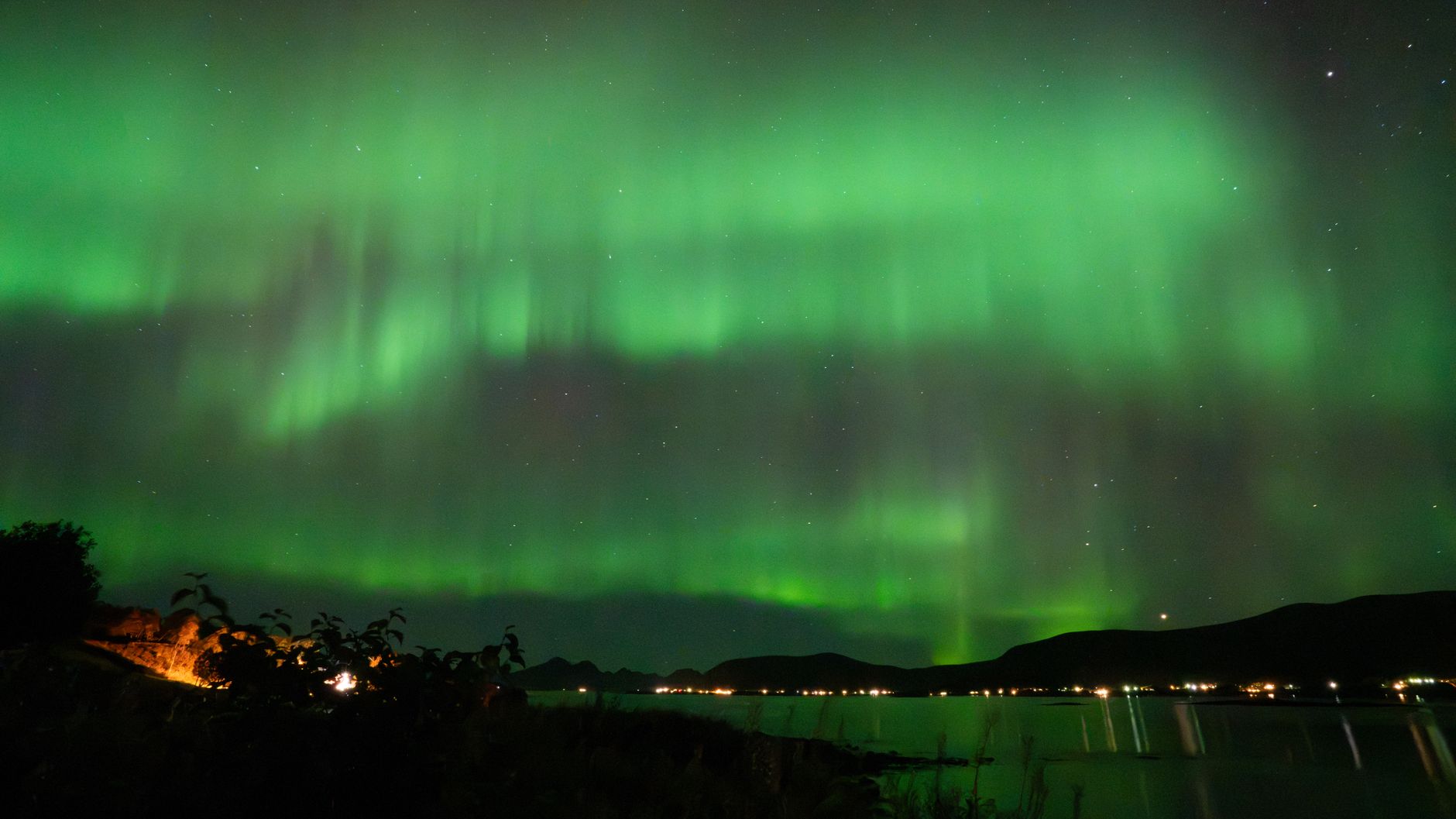
A northern lights quiz round tends to catch people out on the details: what the word “aurora” actually means, which gas makes the green, why some displays have a red top, and whether Earth is the only planet with them. With the long dark evenings back, this guide checks the usual quiz answers against NOAA’s Space Weather Prediction Center, NASA, the Met Office and AuroraWatch UK, a free alert service run by scientists at Lancaster University, all read on 25 November 2026.
Wrong answer: “aurora borealis” means northern lights
Close, but not quite. NASA explains that Aurora is the Latin word for “dawn” and also the name of the Roman goddess of the dawn, so aurora borealis translates to “northern dawn”. NASA links the name to how Europeans living far from the Arctic Circle usually saw auroras: as a faint red glow to the north, resembling the reddish glow in the east at dawn. The southern counterpart is the aurora australis, or southern lights.
Wrong answer: the Sun’s light is reflected in the sky
NOAA’s Space Weather Prediction Center says the aurora is the result of electrons colliding with the upper reaches of Earth’s atmosphere. The electrons follow Earth’s magnetic field down to the polar regions, where they collide with oxygen and nitrogen atoms and molecules. Those atoms and molecules are raised to higher energy states, and when they relax back down they release the energy as light.
Two smaller details make good tie-breakers:
- Protons play a minor part. NOAA says protons cause faint and diffuse aurora that is usually not easily visible to the human eye.
- Height. NOAA says the aurora typically forms 80 to 500 km above Earth’s surface.
NASA’s Space Place adds that the Sun sends out a constant solar wind and occasional solar storms, such as coronal mass ejections.
Wrong answer: the colour depends on the strength of the storm
NASA says the colour of an aurora depends on the type of gas that is hit and where that gas is in the atmosphere. Its figures make a neat answer key:
| Colour | Gas | Approximate height (NASA) |
|---|---|---|
| Green (the most common) | Oxygen | Roughly 100 to 200 km |
| Red | Oxygen | Above 200 km |
| Blue | Nitrogen | About 100 to 200 km |
| Reddish-purple to pink lower edge | Nitrogen | Below about 100 km |
NASA describes green as the most common colour, produced when oxygen is excited by electrons around 100 km above the surface. It also notes that the light from different gases can appear to mix, making auroras look purple, pink or even white.
Wrong answer: auroras only happen on Earth
NASA says auroras can occur on other planets and moons with atmospheres, and lists a string of sightings by spacecraft. Voyager 1 caught a glimpse of auroras on the dark side of Jupiter in 1979, and Hubble, Galileo and Juno have also seen them there. Cassini and other missions observed them on Saturn, MAVEN found them on Mars and Pioneer discovered them on Venus. NASA adds that some moons have shown signs of auroras too.
The site’s solar system quiz traps cover more of the planets.
Wrong answer: midwinter is always the best time to look
NOAA’s viewing tips give a more careful answer. They say the best seasons for aurora watching are around the spring and autumn equinoxes, because of a tendency towards larger geomagnetic storms near the equinoxes. They also stress that it must be dark: at high latitudes the summer midnight sun prevents viewing, so a summer trip to the Arctic usually does not work.
On timing within a night, NOAA says the best aurora is usually within an hour or two of midnight, between 10pm and 2am local time. A full moon reduces the apparent brightness of the aurora, though not its actual brightness. The site’s seasons quiz traps explain the equinoxes themselves.
Wrong answer: you have to go to the Arctic
NOAA says the best place to watch is an oval-shaped region between about 60 and 75 degrees of latitude, where the aurora can be seen on more than half of the nights in a year. During large events the aurora extends towards the equator and can be seen as far south as the US, Europe and Asia.
NOAA measures activity with the planetary K index, or Kp, which runs from 0 to 9. At Kp 0 the edge of the auroral oval sits at about 66 degrees magnetic latitude, moving about 2 degrees towards the equator for each step, to 48 degrees at Kp 9. NOAA notes this works in geomagnetic, not geographic, latitude.
For UK viewers, AuroraWatch UK runs a four-level colour alert based on magnetometer readings:
- Green: aurora unlikely to be visible by eye or camera from anywhere in the UK.
- Yellow: may be visible by eye from Scotland, and by camera from Scotland, northern England and Northern Ireland.
- Amber: likely visible by eye from Scotland, northern England and Northern Ireland, possibly elsewhere; photographs likely from anywhere in the UK.
- Red: likely visible by eye and camera from anywhere in the UK.
AuroraWatch UK adds that local conditions still need to be right. The Met Office also publishes a daily space weather forecast; its forecast read on 25 November 2026 expected faster solar winds from late on 26 November or during 27 November, with the aurora likely to become visible from Scotland, weather permitting.
A quick checklist for quiz setters
- Ask for the Latin meaning (“northern dawn”), not the English nickname.
- Credit oxygen for both green and red, with red higher up.
- Say “electrons” for the main cause, since NOAA calls proton aurora faint.
- Treat Kp limits as approximate, as NOAA itself does.
The bottom line
The northern lights are light given off by oxygen and nitrogen in the upper atmosphere after collisions with electrons guided by Earth’s magnetic field, according to NOAA. NASA traces the name to the Latin for dawn and credits oxygen with both the common green and the higher red. AuroraWatch UK’s colour alerts show when a display may reach UK skies.
Sources
- Aurora, NOAA / NWS Space Weather Prediction Center (swpc.noaa.gov), read 25 November 2026
- Tips on Viewing the Aurora, NOAA / NWS Space Weather Prediction Center (swpc.noaa.gov), read 25 November 2026
- Auroras, NASA Science (science.nasa.gov), read 25 November 2026
- What Is an Aurora?, NASA Space Place (spaceplace.nasa.gov), read 25 November 2026
- Space weather forecast, Met Office (weather.metoffice.gov.uk), forecast read 25 November 2026
- Alerts, AuroraWatch UK, Lancaster University (aurorawatch.lancs.ac.uk), read 25 November 2026
Leave a Reply