
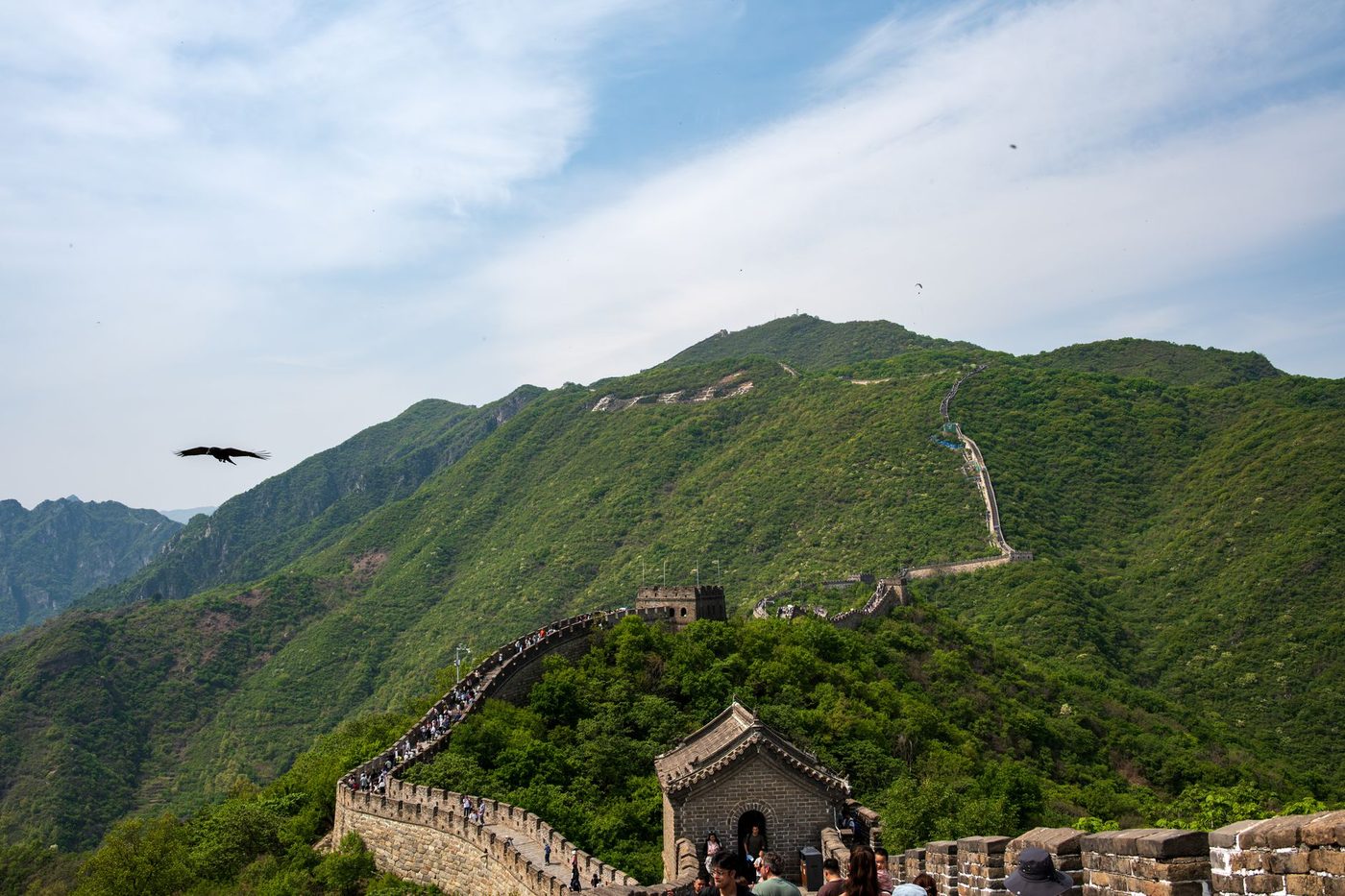
“Is the Great Wall of China the only human-made object visible from space?” is a staple quiz question, and the safe answer depends on three words in it: visible, space and only. NASA has addressed it on several pages, and they do not all describe the same kind of seeing. This guide separates the naked eye, the camera and the radar, and the Earth from the Moon, using five NASA pages.
The Myth in NASA’s Words
A NASA feature on its website, dated 05.09.05 and last updated 30 November 2007, calls the idea “a space-based myth”. It says the Wall, frequently billed as the only human-made object visible from space, “generally isn’t, at least to the unaided eye in low Earth orbit”, and that it certainly is not visible from the Moon. The page is marked as kept online for historical purposes, so it is a dated source. A NASA astronaut photography FAQ, which shows no date, says the same: the Wall is not visible to the naked eye from orbit, as China’s first astronaut, Yang Liwei, who admitted he was unable to see it, demonstrated.
Photographs Are a Different Question
The same feature reports that photographs taken by Leroy Chiao from the International Space Station were determined to show small sections of the Wall in Inner Mongolia, about 200 miles north of Beijing. The first was taken on 24 November 2004 with a 180 mm lens and a digital camera, and the feature calls it the first confirmed photo of the Wall. Chiao himself, it says, did not see the Wall and was not sure the picture showed it. NASA’s Kamlesh Lulla is quoted as saying that the right set of conditions must have occurred, and the feature adds that it was a sunny day and a recent snowfall had helped make the Wall more visible.
A NASA image article posted on 2 April 2009 repeats the point. It says the Wall is not visible from the Moon and is “difficult or impossible to see from Earth orbit without the high-powered lenses” used for the photo. The FAQ adds that the Wall does appear in some recent high-resolution astronaut photographs. So a question that asks about a photograph and one that asks about the naked eye have different NASA answers.
Satellite Instruments and Radar
NASA’s Earth Observatory published an image of the day on 26 May 2001 from an ASTER instrument, acquired on 9 January 2001. Its caption says a low sun angle and light snow cover highlight a section of the Wall, visible as a black line running diagonally through the image. The same caption gives the Wall’s length as 7,240 km (4,500 miles) from Korea to the Gobi Desert. That is the caption’s figure, and this guide does not compare it with figures from other bodies. The 2005 feature adds that sections of the Wall can be seen readily in radar imagery taken by Space Shuttle Endeavour, and Lulla says the Wall is hard to photograph because its materials are about the same colour and texture as the surrounding land.
The Moon Version
The feature says the theory that the Wall could be seen from the Moon dates back to at least 1938, and that it grew until astronauts landed on the lunar surface. It quotes Apollo 12 astronaut Alan Bean describing a mostly white, blue and yellow sphere and saying no human-made object is visible at that scale. NASA’s Moon facts page gives an average distance of 238,855 miles (384,400 kilometers) and says that 30 Earth-sized planets could fit between Earth and the Moon. That page shows no date.
What NASA Says Can Be Seen
Lulla says that from space people can see a lot of things they have made, and that perhaps most visible from low Earth orbit are cities at night. Cities can be seen during the day too, he adds, as can major roadways and bridges, airports, dams and reservoirs. The feature captions one station photograph as showing the ancient pyramids at Giza clearly visible. The FAQ gives a limit on detail: in the most detailed astronaut photographs, each dot on the image equals 6 metres on the ground, so neighbourhood streets can be seen, unless heavily tree-lined, but not individual houses.
Checking a Quiz Question About It
- “Visible to the naked eye from low Earth orbit”: NASA’s feature and FAQ say generally not.
- “Visible from the Moon”: NASA says not visible.
- “Shown in a photograph from the station”: NASA’s 2005 feature reports photos of small sections, the first taken with a 180 mm lens, under favourable conditions.
- “The only human-made object”: NASA lists cities, roadways, bridges, airports, dams and reservoirs among what can be seen from low Earth orbit.
The bottom line
NASA’s pages say the Great Wall of China generally cannot be seen with the unaided eye from low Earth orbit and is not visible from the Moon, though small sections appear in some photographs taken from the International Space Station, under favourable conditions, and in radar imagery. Its 2005 feature is dated and marked as kept for historical purposes, and its other pages are undated or date from 2001 and 2009, so a quiz answer should name the kind of seeing: naked eye, camera, radar or Moon.
Sources
- China’s Wall Less Great in View from Space, NASA (nasa.gov), dated 05.09.05, page last updated 30 November 2007, read 11 November 2026
- Great Wall, NASA image article (nasa.gov), 2 April 2009, read 11 November 2026
- Great Wall of China, NASA Earth Observatory image of the day (science.nasa.gov), 26 May 2001, read 11 November 2026
- Gateway to Astronaut Photography of Earth: FAQ, NASA (eol.jsc.nasa.gov), page shows no date, read 11 November 2026
- Moon facts, NASA Science (science.nasa.gov), page shows no date, read 11 November 2026
Leave a Reply