This guide collects the numbers attached to rainbows, such as how many colours, which angle, how many reflections and how much of the circle can be seen, from three sources: a Met Office page on rainbows, the National Weather Service forecast office at Flagstaff, Arizona, and a National Environmental Satellite, Data, and Information Service (NESDIS) page written by the NASA Space Place team and published on 2 September 2025. The Met Office and National Weather Service pages are undated.
42 Degrees, and a Sun That Must Sit Low
The National Weather Service page traces one ray of sunlight through a raindrop: it is refracted on entering, reflected once from the inside surface and refracted again on leaving. It calls the ray with the smallest angle of deviation the rainbow ray, says that much of the light is focused along that path, and gives the angle created in its diagram as 42 degrees. The page lists three ingredients for seeing a rainbow: the sun at the viewer’s back with rain in front, the sun less than 42 degrees above the horizon, and the sun’s rays hitting the raindrops.
The page adds that the lower the sun is to the horizon, the more of the circle is seen, that at sunset the top of the arch would be 42 degrees above the horizon, and that if the sun is more than 42 degrees above the horizon no rainbow will be visible. The Met Office says that when the Sun is high, only a small arc may be visible above the horizon.
Seven Colours, or a Continuous Range?
The Met Office gives the classic order as red, orange, yellow, green, blue, indigo and violet, with red having the longest wavelength and violet the shortest. It then says Isaac Newton popularised the idea of seven distinct colours, that a rainbow actually contains a continuous range of hues, far more than the human eye can distinguish, and that modern definitions often merge indigo into blue and violet while the seven-colour sequence remains a helpful mnemonic.
The NESDIS page explains the order: sunlight is made of many wavelengths, some of which bend more than others on entering the droplet, violet bending the most and red the least.
Red on Top or Red on the Bottom?
The answer depends on which bow is meant. The National Weather Service page says the primary rainbow shows blue along the inner portion of the bow and red on the outside edge. The NESDIS page says violet will be on the bottom and red on the top of the primary bow. The pages word it differently, with the outside edge on one and the top on the other.
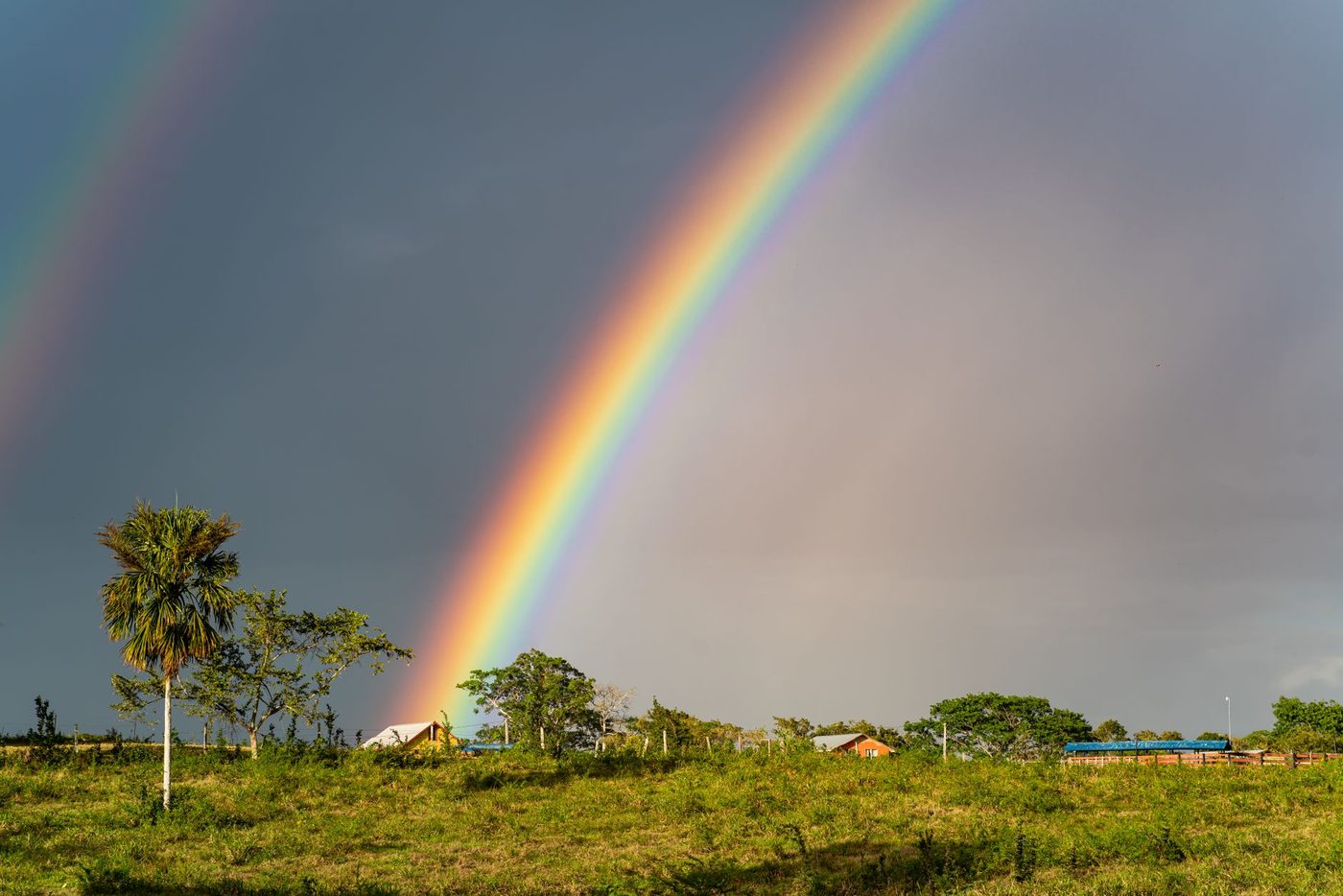
For a double rainbow both pages say the colours of the fainter secondary bow are reversed from the primary. The NESDIS page puts red on the bottom and violet on top for the secondary bow, and says it appears above the primary. The Met Office says the secondary bow appears outside the primary one, with its colours reversed.
Two Reflections and a Darker Band
The National Weather Service page says the primary rainbow is produced from one internal reflection and the secondary rainbow from two internal reflections, with the rays leaving the drop the second time at around 50 degrees, against 42 degrees for the primary. It adds that light can be reflected more than twice within a drop, but that these additional rainbows are typically never seen under normal circumstances.
The Met Office names the dark area between the two bows Alexander’s band, and says it appears darker because no sunlight is scattered toward the observer there.
One Full Circle
The three sources describe a rainbow as a circle, or in the National Weather Service’s words a group of nearly circular arcs of colour with a common centre, of which the earth hides part. The NESDIS page says a full rainbow is a complete circle and that from an aeroplane, in the right conditions, an entire circular rainbow can be seen. The Met Office adds that from elevated viewpoints, such as a mountain or an aeroplane, a full circle rainbow might be seen. The NESDIS page also says a rainbow is not really a thing and does not exist in a particular place: it is an optical phenomenon that appears when the conditions and the viewer’s position are right.
Fogbows and Moonbows
The Met Office also describes two variants. Fogbows, or white rainbows, form in fog, mist or cloud, where the droplets are much smaller than raindrops, so the light is diffracted and the colours smeared out. They appear pale or nearly colourless and are broader than typical rainbows. Moonbows are created by moonlight instead of sunlight; the Met Office says they are rare, usually appear white to the naked eye and need a nearly full and low moon, a dark sky and water droplets opposite the moon.
Where the Pot of Gold Came From
The National Weather Service page says that as far back as the 17th century people knew the complete circle of a rainbow cannot be seen, and that in Ireland in the 17th century people became fond of saying one was as likely to find a pot of gold as to find the end of the rainbow. It says the expression somehow changed and became part of mythology.
The bottom line
On these three pages, the numbers given are 42 degrees for the primary bow, around 50 degrees for the secondary, one internal reflection for the primary and two for the secondary, with the sun needing to be less than 42 degrees above the horizon (National Weather Service). The Met Office treats seven colours as a convention over a continuous range, and all three sources describe the bow as part of a circle. For the colour order, the National Weather Service puts red on the outside edge of the primary bow and NESDIS puts it on top, with the secondary bow reversed on both pages.
Sources
- Rainbows: optical wonders, Met Office (metoffice.gov.uk), page undated, read 13 November 2026
- How Do Rainbows Form?, National Weather Service, NWS Flagstaff, AZ (weather.gov), page undated, read 13 November 2026
- What Causes a Rainbow?, NESDIS, NOAA (nesdis.noaa.gov), published 2 September 2025, read 13 November 2026
Leave a Reply