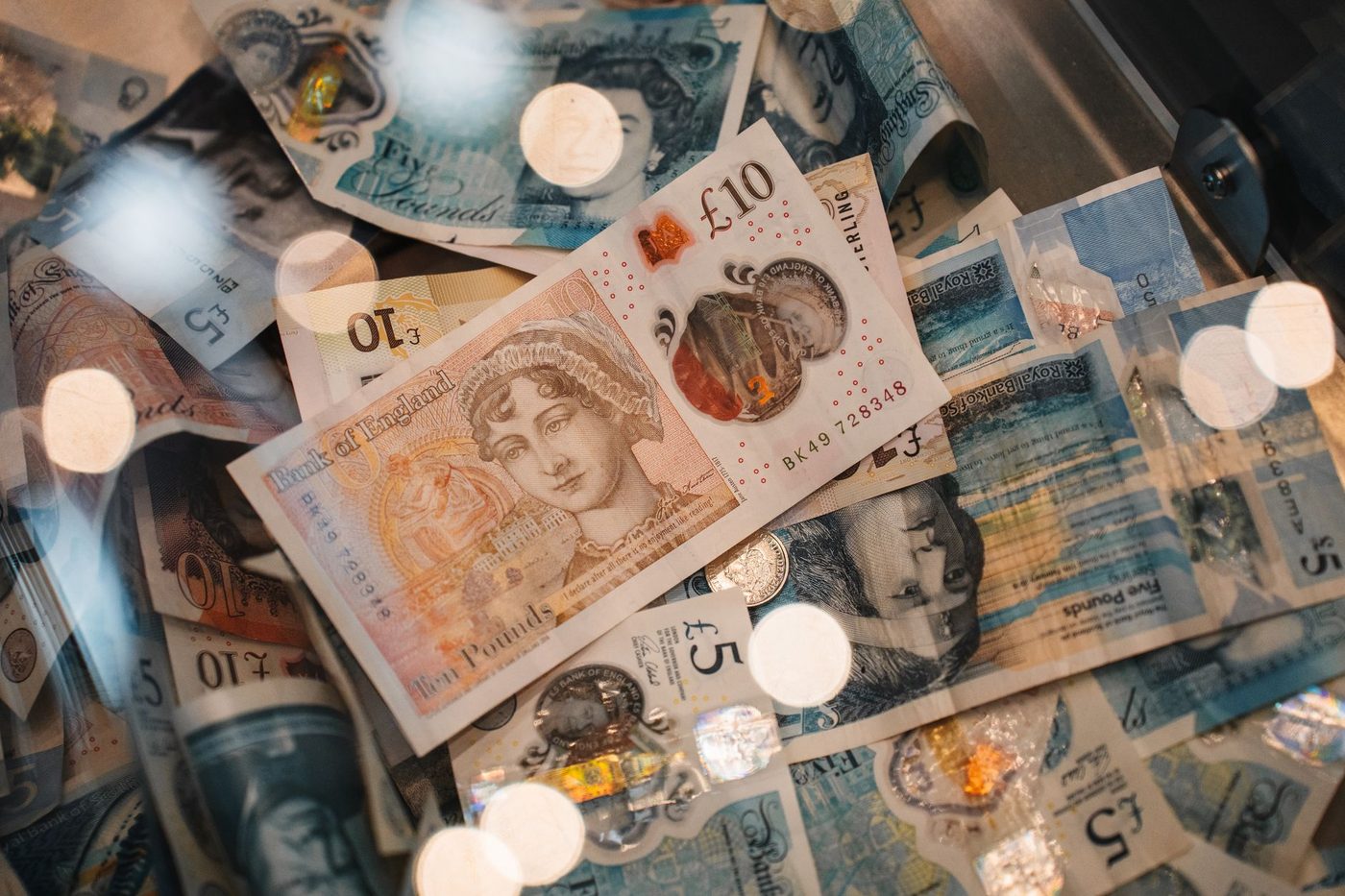
The Bank of England says there are four denominations of its banknotes in circulation, the £5, £10, £20 and £50, and that each features the portrait of either King Charles III or the late Queen Elizabeth II (Current banknotes page, updated 5 January 2026). The Bank’s own note pages give dates, quotations, artworks and even single letters in foil patches. This article collects those facts, and the details a quiz question could hinge on.
Four notes, four faces, four dates
The Bank describes the current £5 as featuring the politician Sir Winston Churchill, the £10 the author Jane Austen, the £20 the artist JMW Turner and the £50 the scientist Alan Turing. Its note pages give the sequence of each announcement and first issue:
| Note | Face | Announced | Current note issued | Approximate size |
|---|---|---|---|---|
| £5 | Sir Winston Churchill | 26 April 2013 | 13 September 2016 | 125mm x 65mm |
| £10 | Jane Austen | 24 July 2013 | 14 September 2017 | 132mm x 69mm |
| £20 | JMW Turner | 22 April 2016 | 20 February 2020 | 139mm x 73mm |
| £50 | Alan Turing | 15 July 2019 | 23 June 2021 | 146mm x 77mm |
Each page says the higher the value of a note, the larger it is, which the sizes above reflect. The announcement date and the date the current note was issued differ for every note.
The King’s portrait and the Queen’s notes
The Bank began issuing notes with King Charles III’s portrait on 5 June 2024, placing the portrait on the existing designs of all four notes with no other changes. Notes with Queen Elizabeth II’s portrait, it says, remain legal tender and circulate alongside the new ones, and there is no need to exchange them. New King Charles III notes are printed only to replace worn notes and to meet any overall increase in demand, in line with guidance from the Royal Household (King Charles III banknotes page, updated 2 February 2026).
Quotations, artworks and foil letters
The Bank’s feature descriptions are rich in quiz material. The £5 note carries a quotation from Churchill’s first speech as Prime Minister, “I have nothing to offer but blood, toil, tears and sweat”, and a view of Westminster and the Elizabeth Tower alongside an image of the Nobel Prize medal. Its portrait is from a photograph taken in 1941 by Yousuf Karsh, and a circular green foil patch contains the letters spelling BLENHEIM.
On the £10, the Bank says Jane Austen’s portrait was commissioned by her nephew in 1870. The artwork is an illustration of Elizabeth Bennet from Pride and Prejudice with Godmersham Park House, and the quotation, about there being no enjoyment like reading, was said by Miss Bingley in that novel. A book-shaped copper foil patch contains the letters JA.
The £20 uses a self-portrait painted circa 1799 and now on display at Tate Britain, with The Fighting Temeraire as the artwork. Its quotation, “Light is therefore colour”, is from a lecture Turner gave in 1818, and his signature is taken from the will in which he left many of his paintings to the nation. A round purple foil patch contains the letter T.
On the £50, the portrait is based on a photograph owned by the National Portrait Gallery. The quotation is from an interview Turing gave to The Times on 11 June 1949, and the signature comes from the visitors’ book on display at Bletchley Park Trust. A red foil patch contains the letters AT. The Bank also says the £10, £20 and £50 notes carry two, three and four clusters of raised dots respectively to help blind and partially sighted people identify the value; the £5 page does not mention raised dots.
Not every UK banknote comes from the Bank of England
The Bank says only it issues banknotes in England and Wales, but six banks in Scotland and Northern Ireland can also do so. Three are authorised in Scotland: Bank of Scotland plc, Clydesdale Bank Limited and The Royal Bank of Scotland plc. Three are authorised in Northern Ireland: Bank of Ireland (UK) plc, Northern Bank Limited (which trades as Danske Bank) and National Westminster Bank plc (which trades as Ulster Bank in Northern Ireland). The Bank adds that coins are issued by the Royal Mint, and that AIB Group (UK) plc ceased issuing banknotes on 30 June 2020 (Scottish and Northern Ireland banknotes page, updated 1 October 2026).
The same page says the six banks’ backing assets can include Bank of England banknotes, and that some of those banknotes are of very high value, including £1 million banknotes known as Giants and £100 million banknotes known as Titans.
Retired notes and their last day
The Bank’s list of withdrawn banknotes (updated 1 July 2025) gives dates when notes ceased to be legal tender. The £20 Series F and £50 Series F both ceased on 30 September 2022. The £5 Series E variant ceased on 5 May 2017 and the £10 Series E variant on 1 March 2018.
The bottom line
On the Bank of England’s own pages, Churchill is on the £5, Austen on the £10, Turner on the £20 and Turing on the £50. Announcement and issue dates differ for each, the King’s portrait was added to the existing designs from 5 June 2024 while Queen Elizabeth II notes remain legal tender, and six banks in Scotland and Northern Ireland can issue notes of their own.
Sources
- Current banknotes, Bank of England, page last updated 5 January 2026, read 1 November 2026 (bankofengland.co.uk)
- £5 note, £10 note, £20 note and £50 note, Bank of England, pages last updated 4 August 2025, read 1 November 2026 (bankofengland.co.uk)
- King Charles III banknotes, Bank of England, page last updated 2 February 2026, read 1 November 2026 (bankofengland.co.uk)
- Scottish and Northern Ireland banknotes, Bank of England, page last updated 1 October 2026, read 1 November 2026 (bankofengland.co.uk)
- Withdrawn banknotes, Bank of England, page last updated 1 July 2025, read 1 November 2026 (bankofengland.co.uk)
Leave a Reply